Tips for Choosing the Right Landscaping Company
Comparing Pool Deck Materials: Concrete, Natural Stone, and Pavers
When homeowners plan a new pool, most of the attention naturally goes to the water. Pool shape. Features. Lighting. Steps. Seating. All the fun stuff.
But the surface surrounding the pool matters just as much.
Your pool deck affects how the space looks, how comfortable it feels under bare feet, how well it drains after swimmers get out, and how the area holds up over time. The right material can elevate the entire backyard. The wrong one can create maintenance headaches and uncomfortable surfaces.
Three materials usually come up when discussing pool decks: concrete, natural stone, and pavers. Each has its own advantages and tradeoffs. Understanding those differences can help you choose the option that works best for your backyard.
What a Pool Deck Needs to Handle
Pool decks are an unsung hero of the entire backyard. They serve as a transitional space between water and land, a place to lounge, and a buffer for your pool.
A well-designed pool deck needs to provide:
- Slip resistance when the surface gets wet
- Heat absorption so the surface stays comfortable in the sun
- Drainage so water does not pool around the deck
- Durability against foot traffic, furniture, and weather
Choosing the right material means balancing all of these factors while still creating a space that feels beautiful and inviting.
Concrete Pool Decks: Benefits and Drawbacks
Concrete is one of the most widely used materials for large standing areas. It’s a familiar option and often one of the more affordable surfaces to install.
Benefits of Concrete Pool Decks
Concrete provides a clean, simple surface and can be shaped to fit almost any layout. Many homeowners are familiar with the classic broom-finish concrete deck, which creates a slightly textured surface that improves traction.
Decorative options have also become more common. Stamped concrete can mimic the look of stone or tile while adding visual interest compared to a plain slab.
Drawbacks of Concrete Pool Decks
Despite its popularity, concrete comes with several limitations around pools.
Because the deck is poured as one large slab, cracks can become a bigger issue over time. If one section fails, repairs can be difficult and sometimes require replacing larger portions of the deck.
Concrete also doesn’t always perform as well in areas that experience constant moisture and temperature swings, which are common around pools. Over time, those conditions can accelerate wear.
Concrete can also get extremely hot in direct sunlight. You need to consistently apply sealant to keep the surface area from getting too hot for your skin to handle.
Natural Stone Pool Decks: Benefits and Drawbacks
Natural stone is often chosen for its luxurious appearance and distinctive character. Materials like travertine, limestone, and bluestone can create a striking poolside environment.
Benefits of Natural Stone Pool Decks
Many homeowners appreciate the organic look of natural stone. Each piece has its own color variations and textures, which gives the deck a unique and high-end feel. Natural stone can work particularly well for backyards designed to resemble a resort-style or natural landscape setting.
Drawbacks of Natural Stone Pool Decks
While natural stone can look beautiful, it also comes with some practical considerations.
If a section becomes damaged, matching replacement pieces can be difficult, especially if the original material came from a specific quarry.
Some types of natural stone can also feel rough or uncomfortable under bare feet, which becomes noticeable when people are walking back and forth between the pool and seating areas.
Paver Pool Decks: Benefits and Drawbacks
For many pool projects, pavers offer a balance of durability, flexibility, and design options that work particularly well around water.
Benefits of Paver Pool Decks
One of the biggest advantages of pavers is how they handle long-term wear.
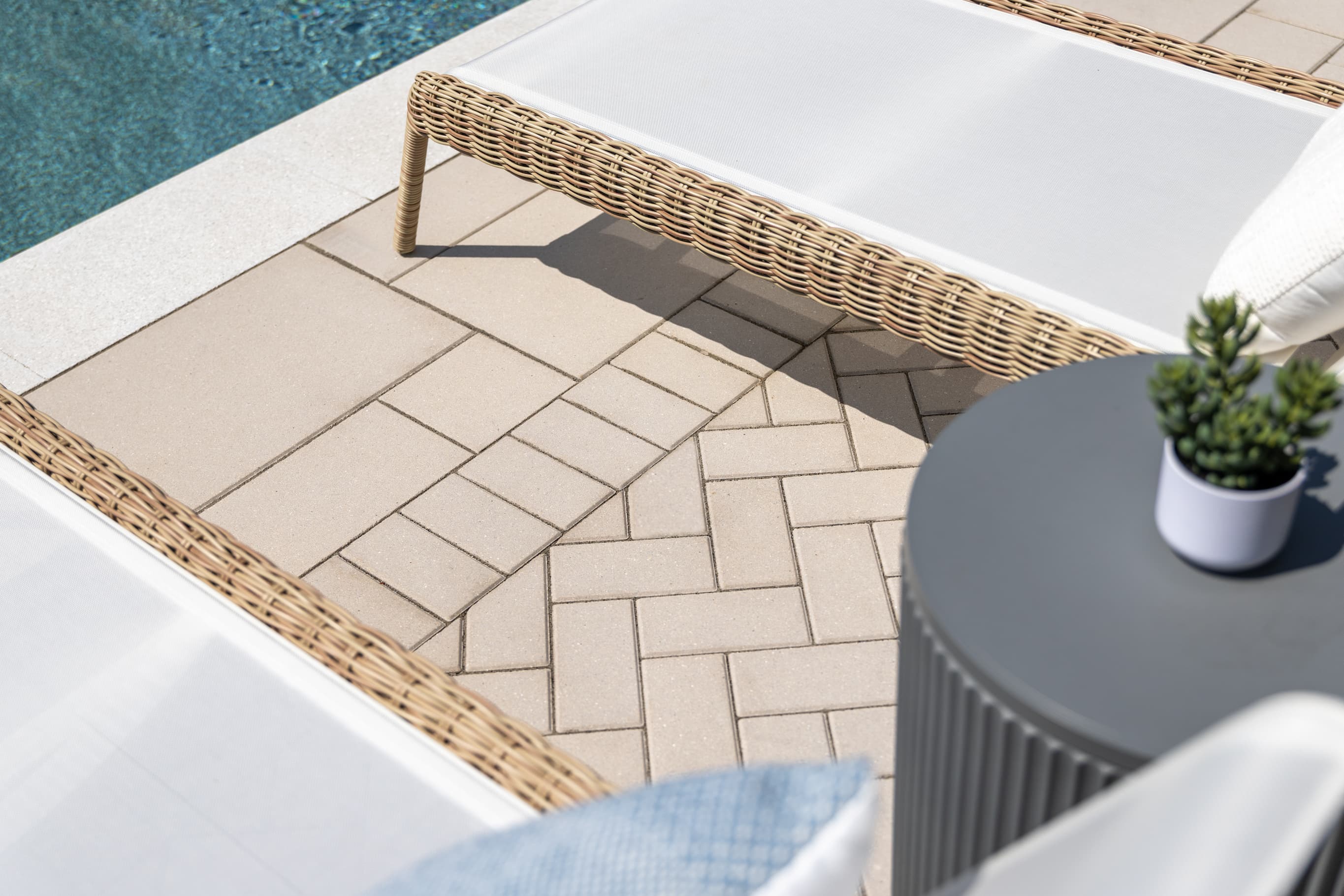
Unlike concrete, pavers are installed as individual units rather than one continuous surface. If one section becomes damaged, it can be replaced without disturbing the rest of the deck. This makes maintenance and repairs far simpler over time.
Pavers also offer tremendous design flexibility. They come in a wide range of colors, textures, shapes, and patterns, making it easier to create a pool deck that complements the surrounding patio, landscaping, and home architecture.
Homeowners who love the look of natural stone can even choose natural stone pavers, which combine the beauty of stone with the practical advantages of a modular paver system.
Another major benefit is water management. Because pavers are installed with small joints between pieces, water can move between the pavers and drain more efficiently. The surface can also shift slightly with ground movement without cracking.
Related Content: The Benefits of Paver Patios
Drawbacks of Paver Pool Decks
The primary consideration with pavers is the installation process. Proper base preparation and installation are essential to ensure the deck remains stable and level over time.
Working with an experienced installer helps ensure the paver system performs as intended.
Side-by-Side Comparison of Pool Deck Options
Now that we’ve gone through each of the major options, let’s look at them side-by-side to see how they compare.
|
Feature |
Concrete |
Natural Stone |
Pavers |
|
Durability |
Solid surface but prone to cracking |
Durable but replacement pieces may be difficult to match |
Individual units reduce large-scale damage |
|
Maintenance |
Larger sections often need replacement. Needs to be sealed yearly. |
Replacement stones may be hard to source. Needs to be sealed yearly. |
Individual pavers can be swapped out. Sealing optional, but recommended every 3-5 years. |
|
Design Options |
Limited unless stamped |
Natural, high-end appearance |
Wide range of patterns and colors |
|
Comfort Underfoot |
Can become hot |
Stones can feel rough |
Comfortable for bare feet |
|
Drainage |
Surface runoff only |
Depends on installation |
Water moves between joints |
Why Many Minnesota Pool Projects End Up Using Pavers
Minnesota’s climate places unique demands on outdoor materials.
Freeze-thaw cycles cause the ground to shift throughout the year. Materials that cannot adapt to that movement often crack or deteriorate over time.
Because pavers are installed as individual units, they can move slightly without breaking, helping the deck adapt to seasonal changes.
They also handle water well. The joints between pavers allow moisture to move away from the surface, while the flexible structure helps manage ground movement.
And if a section ever needs attention, repairs remain simple: replace the affected paver instead of rebuilding the entire deck.
For many homeowners planning a pool in Minnesota, these advantages make pavers a practical and long-lasting choice.
Outdoor Innovations Landscaping creates elevated backyards for homeowners across Minnesota. From in-ground pools to luxurious grilling stations to outdoor living rooms, we design spaces that make it easy to relax, entertain, and spend time outside.
Outdoor Innovations Landscaping creates exquisite backyards for homeowners in Minnesota. From in-ground pools to luxurious paver patios to outdoor living rooms, we do it all. Explore our past projects and get a quote online to make your dream backyard a reality.